30 Recommended Autumn Foliage Spots in Kyoto

We provide detailed information on the usual best time to see the autumn foliage, illumination details, and useful access tips for when you actually visit. Don't forget to check out convenient tours and activities that allow you to fully experience Kyoto's fall colors.
*This article is translated using ChatGPT.
For the latest information on each tourist spot and facility, we recommend checking the official website.
- 日本 、京都府
INDEX
When is the best time to see autumn foliage in Kyoto?
Social Media Buzz: Kodai-ji Temple
【Trending on SNS】Rurikoin Temple
Arashiyama, Sagano, and Takao Area
【Buzz on Social Media】Zuishinin Temple
Uji City and Nagaokakyo City Area
Experience the Stunning Beauty! Let's Visit Kyoto in its Splendid Autumn Colors
When is the best time to see autumn foliage in Kyoto?
When it comes to Kyoto's autumn foliage, the best time to see it actually varies depending on the area.
Broadly speaking, the timing differs between the urban areas and the mountainous regions. In the urban areas, the foliage is usually at its peak around mid to late November. On the other hand, in mountainous areas such as Takao, Kibune, and Ohara, the foliage tends to reach its peak around early to mid-November. Due to the relatively cooler temperatures in these mountainous regions, the foliage tends to arrive a little earlier than in the urban areas.
Gion and Higashiyama Area
Gion and Higashiyama area is a collection of iconic tourist spots that represent Kyoto, including well-known temples and shrines like Kiyomizu-dera and Yasaka Shrine, the picturesque Hanami-koji street with its traditional Kyoto townhouses, and the Kamogawa River, one of Kyoto's representative rivers. Let's introduce six must-visit autumn foliage spots in this area.
Classic: Tofuku-ji Temple

Best Time to Visit
Late November to early December
What is Tofuku-ji Temple?
Located along the valley at the foot of Mt. Tofuku in Higashiyama, Tofuku-ji Temple is the head temple of the Rinzai Zen Tofuku-ji school, founded during the Kamakura period. It is the fourth-ranked Zen temple among Kyoto's five mountains and features impressive large temple buildings and notable attractions such as the Sanmon Gate (national treasure) and the Hōjō Garden (Eight Views Garden), designated as a national scenic spot.
Highlights of the Autumn Foliage
When it comes to Tofuku-ji Temple, the breathtaking view of foliage that spreads like a sea of clouds in the valley called "Senbontaki" is a must-see. The view from the "Tsūtenkyō Bridge" is particularly spectacular and attracts many visitors during the autumn season. Tofuku-ji Temple is home to around 2,000 maple trees, including the "Tsūten Momiji" with golden leaves that split into three tips instead of the usual five.
Detailed Information
- Access: Approximately 10 minutes on foot from JR and Keihan "Tofuku-ji Station," approximately 5 minutes on foot from the city bus "Tofuku-ji"
- Address: 778 Honmachi 15-chome, Higashiyama-ku, Kyoto / Parking available
- Phone Number: 075-561-0087
- Opening Hours: April to end of October: 9:00 AM to 4:00 PM (last admission at 4:00 PM) / November to first Sunday in December: 8:30 AM to 4:00 PM (last admission at 4:00 PM) / First Monday in December to end of March: 9:00 AM to 3:30 PM (last admission at 3:30 PM)
- Admission Fee: Tofuku-ji Main Garden (Hōjō): 500 yen for both regular and autumn periods / Tsūtenkyō Bridge and Kaizandō: 600 yen for regular periods, 1000 yen for autumn period / Combined ticket for Tofuku-ji Main Garden (Hōjō), Tsūtenkyō Bridge, and Kaizandō: 1000 yen for regular periods, no autumn period. *Autumn period: November 10th to November 30th
- Night Special Visit and Illumination: To be determined for 2022 (previously held in 2021)
Social Media Buzz: Kodai-ji Temple

Best Time to Visit
Mid-November to early December
What is Kodai-ji Temple?
Kodai-ji Temple is a temple of the Rinzai Zen Kennin-ji school, established in 1606 by Nene, the wife of Toyotomi Hideyoshi, to pray for his eternal peace. It features important cultural properties such as the "Kangetsudai" moon-viewing platform, where Nene is said to have gazed at the moon, and the "Reiyokan" mausoleum where Nene is buried. Visitors can experience the deep connection to Hideyoshi and the vibrant culture of the Azuchi-Momoyama period.
Highlights of the Autumn Foliage
The "Hashin-tei" garden within the Hōjō (Abbot's Quarters) is illuminated with projection mapping and offers stunning light displays throughout the seasons. During the autumn foliage season, the illuminated leaves in the "Garyō-ike Pond" reflect like a mirror. When the maple trees on both sides of the entrance slope called "Daisuzaka" turn color, it feels like passing through a tunnel of vibrant autumn leaves.
Detailed Information
- Access: Approximately 10 minutes on foot from Keihan "Gion-Shijo Station," approximately 15 minutes on foot from Hankyu "Kyoto-Kawaramachi Station," approximately 7 minutes on foot from the city bus "Higashiyama Yasui"
- Address: 526 Shimokawaramachi, Higashiyama-ku, Kyoto / Parking available
- Phone Number: 075-561-9966
- Opening Hours: 9:00 AM to 5:30 PM (last admission at 5:00 PM) / Night Special Visit: Illumination from 5:00 PM to 10:00 PM (last admission at 9:30 PM)
- Admission Fee: 600 yen
- Night Special Visit and Illumination: Scheduled from October 21st to December 11th, 2022
Kiyomizu-dera Temple

Best Time to Visit
Late November to early December
What is Kiyomizu-dera Temple?
Kiyomizu-dera Temple is an incredibly famous and popular tourist spot in Kyoto, registered as a UNESCO World Heritage site as one of the "Historic Monuments of Ancient Kyoto." It features the iconic "Honden" (Main Hall) known as the "Kiyomizu Stage," the main gate called "Niōmon," the towering three-story pagoda standing at approximately 31 meters (the tallest in Japan), and the renowned "Otawa Waterfall," known as a power spot. The temple offers a rich array of attractions.
Highlights of the Autumn Foliage
If you want to capture a single photo of Kiyomizu-dera Temple's iconic "Kiyomizu Stage," autumn foliage, and a distant view of Kyoto's cityscape, it is recommended to take your camera from the "Okunoin" and "Koando" areas. The valley spreading below the stage is called "Kinunkei" and is adorned with approximately 1,000 vibrant maple trees. Kiyomizu-dera Temple also holds illumination events and special night visits during the autumn foliage season, allowing visitors to enjoy its enchanting beauty.
Detailed Information
- Access: Approximately 10 minutes on foot from the city bus "Kiyomizu-michi" or "Gojozaka"
- Address: 294 Kiyomizu 1-chome, Higashiyama-ku, Kyoto / No parking available
- Phone Number: 075-551-1234
- Opening Hours: 6:00 AM to 6:00 PM / Night Special Visit during spring, summer, and autumn: 6:00 AM to 9:30 PM (last admission at 9:00 PM)
- Admission Fee: 400 yen
- Night Special Visit and Illumination: Scheduled from November 18th to November 30th, 2022
Hidden Gem: Sennyu-ji Temple

Best Time to Visit
Mid-November to late November
What is Sennyu-ji Temple?
Sennyu-ji Temple is the head temple of the Shingon sect's Sennyu-ji school. It houses 39 tombs, including the imperial mausoleums of 14 emperors from Emperor Shijo onwards, as well as the mausoleums of empresses and princes. Due to its deep connection with the imperial family throughout history, it is also called the "Goteri" (Imperial Temple).
Highlights of the Autumn Foliage
In the "Gosado Garden," which spreads in front of the relocated imperial residence, you can enjoy the elegant and beautiful autumn foliage scenery with subtle gradations. You can sit on the veranda and spend a refined moment. This spot is not as crowded as others, allowing you to leisurely enjoy the autumn colors in the spacious temple grounds.
Detailed Information
- Access: Approximately 20 minutes on foot from JR and Keihan "Tofuku-ji Station," approximately 15 minutes on foot from the city bus "Sennyu-ji-michi"
- Address: 27 Sennyu-ji Yamauchicho, Higashiyama-ku, Kyoto / Parking available
- Phone Number: 075-561-1551
- Opening Hours: March to November: 9:00 AM to 5:00 PM (last admission at 4:30 PM) / December to February: 9:00 AM to 4:30 PM (last admission at 4:00 PM)
- Admission Fee: Temple Area Admission (Main Gate, Buddha Hall, Yang Gui Fei Kannon Hall, Spring Water House, Relic Hall, Shinsho Hall): 500 yen / Special Visit (Imperial Residence, Gosado Garden, Kai-kaido Hall): 300 yen
- Night Special Visit and Illumination: Not implemented in previous years
Shorenin Monzeki

Best Time to Visit
Late October to early December
What is Shorenin Monzeki?
Shorenin Monzeki is a prestigious temple of the Tendai sect, deeply connected to the imperial family throughout history. It is known for housing the national treasure "Aofudo," one of Japan's three famous Fudo deities. The vibrant lotus-themed sliding doors in the reception hall, known as the "Kacho-den," have become a popular topic on social media, offering a unique collaboration between contemporary art and a temple.
Highlights of the Autumn Foliage
The temple features a stunning strolling pond garden, one of Kyoto's finest, designed by the renowned artist Sōami during the Muromachi period. During the autumn foliage season, the vibrant colors of the maple leaves complement the garden, which represents the world of paradise.
Detailed Information
- Access: Approximately 5 minutes on foot from the subway "Higashiyama Station," approximately 3 minutes on foot from the city bus "Jingu-michi"
- Address: 69-1 Awataguchi Sanjo-bōchō, Higashiyama-ku, Kyoto / Parking available
- Phone Number: 075-561-2345
- Opening Hours: 9:00 AM to 5:00 PM (last admission at 4:30 PM)
- Admission Fee: 500 yen
- Night Special Visit and Illumination: To be determined for 2022 (previously held in 2021)
Chion-in Temple
Best Time to Visit
Mid-November to early December
What is Chion-in Temple?
Chion-in Temple, founded in 1175, is the head temple of the Jodo sect and holds deep significance as the birthplace of the founder, Hōnen Shōnin. It is home to the national treasures "Mieido" (Founder's Hall) and "Sanmon" (main gate), as well as two main gardens: the "Hojo Garden" created by the renowned garden designer Kobori Enshu during the Edo period, and the "Yūzen-en Garden," which was renovated in the Showa period to commemorate the 300th anniversary of the birth of the founder of Yuzen dyeing, Miyazaki Yuzen.
Highlights of the Autumn Foliage
With approximately 200 maple trees planted throughout the vast temple grounds, the foliage along the approach leading to the main bell tower is a must-see. During the autumn foliage season, the temple holds illuminations, offering a unique beauty at night. The illuminated "Mieido" where the image of the founder, Hōnen Shōnin, is enshrined, the national treasure "Sanmon" (Triple Gate), and the "Yūzen-en Garden" associated with Miyazaki Yuzen, the founder of Yuzen dyeing, showcase a special charm in the evening.
Detailed Information
- Access: Approximately 8 minutes on foot from the subway "Higashiyama Station," approximately 15 minutes on foot from Hankyu "Kyoto-Kawaramachi Station," approximately 10 minutes on foot from Keihan "Gion-Shijo Station," approximately 5 minutes on foot from the city bus "Chion-in-mae"
- Address: 400 Hayashi-shita-chō, Higashiyama-ku, Kyoto / No parking available
- Phone Number: 075-541-5142
- Opening Hours: 9:00 AM to 4:00 PM / Hojo Garden: 9:00 AM to 3:50 PM
- Admission Fee: Yuzen-en Garden: 300 yen / Hojo Garden: 400 yen / Combination Ticket for Yuzen-en and Hojo Gardens: 500 yen
- Night Special Visit and Illumination: To be determined for 2022 (previously held in 2021)
Hotels in Gion and Higashiyama Area
Hotel The Celestine Kyoto Gion
Located in a quiet area, perfect for exploring the Higashiyama area with attractions such as Kiyomizu-dera Temple and Yasaka Shrine. It also offers a great location close to the Kamogawa River.
Kyoto Granbell Hotel
A designer hotel with a prime location, just a 2-minute walk from Gion-Shijo Station. It combines modern aesthetics with traditional Japanese beauty.
Rakuchu and Okazaki Area
The Rakuchu area in the heart of Kyoto's city center is a hub of tourist attractions, ranging from historical sites like Kyoto Imperial Palace and Nijo Castle to modern spots like Kyoto Station and Kyoto Tower. Alongside the tranquil and charming Okazaki area, we present seven must-visit autumn foliage spots in this area.
Eikando Temple (Eikan-do)

Best Time to Visit
Mid-November to late November
What is Eikando Temple?
Eikando Temple, also known as Zenrin-ji, is the head temple of the Jodo sect's Higashiyama Zenrin-ji school, founded during the Heian period. The temple is famous for its rare statue of Amida Nyorai, known as "Mikaeri Amida," which depicts Amida Nyorai gently smiling and looking back over his shoulder. Exploring the temple grounds and discovering the Seven Wonders (Fleeing Sparrows, Plum Tree of Sorrow, Lying Dragon Corridor, Mats of the Three Treasures, Wooden Fish Frog, Fire-protecting Amida Nyorai, and Rock Wall Maple) is also recommended.
Highlights of the Autumn Foliage
Eikando Temple, often referred to as "Momiji no Eikando" (Eikando of Maple Leaves), has been celebrated for its beauty since ancient times, even appearing in the Heian period's poetry anthology. The temple grounds are adorned with approximately 3,000 maple trees, with popular attractions including the "Iwagaki Maple" growing on a steep slope near the Tahoto Pagoda and the mesmerizing sight of "Sakasa Momiji" (inverted maple leaves) reflecting on the surface of the Hojo Pond.
Detailed Information
- Access: Approximately 15 minutes on foot from the subway "Keage Station," approximately 3 minutes on foot from the city bus "Nanzenji-Eikando-michi"
- Address: 48 Eikando-cho, Sakyo-ku, Kyoto / Parking available (Note: Parking is prohibited during the autumn temple treasures exhibition)
- Phone Number: 075-761-0007
- Opening Hours: 9:00 AM to 5:00 PM (last admission at 4:00 PM) Admission Fee: 600 yen / Autumn Temple Treasures Exhibition: 1000 yen / Illumination: 600 yen
- Illumination and Autumn Temple Treasures Exhibition: Scheduled from November 5 to December 4, 2022 / Illumination: 5:30 PM to 9:00 PM (last admission at 8:30 PM)
Philosopher's Path

Best Time to Visit
Mid-November to early December
What is the Philosopher's Path?
The Philosopher's Path is a approximately 2-kilometer walking path that connects Jishoji Ginkaku (Silver Pavilion) and Kumano Nyakuoji Shrine. It is said to have acquired its name, "Philosopher's Path," because renowned philosophers such as Kitaro Nishida and economists like Hajime Kawakami used to walk along this path, contemplating and meditating.
Highlights of the Autumn Foliage
One of the attractions of the Philosopher's Path is the leisurely stroll along the waterway while enjoying the view of maple trees. The surrounding area is home to renowned autumn foliage spots such as Eikando Temple, Nanzenji Temple, and Ginkaku-ji (Silver Pavilion), making it recommended to explore these attractions together.
Detailed Information
- Access: If starting from the north side, it is just a short walk from the city bus stop "Ginkaku-ji Michi." If starting from the south side, it is also a short walk from the city bus stop "Miyanomae."
- Address: Jodoji Shimonandacho, Sakyo-ku, Kyoto / No parking available
【Hidden Gem】Shinnyodo Temple
Best Time to Visit
Late November to early December
What is Shinnyodo Temple?
Shinnyodo Temple, formally known as "Shinshin Gokuraku-ji," is a Tendai Buddhist temple affiliated with Mt. Hiei's Enryaku-ji. It is often called the "Truly Paradise Temple." The temple is renowned for its statue of Amida Nyorai, affectionately known as the "Nodding Amida," and its beautiful garden called the "Nehan Garden," which depicts the final moments of Buddha's life against the backdrop of the Higashiyama mountain range, including the famous Daimonji mountain known for its Gozan no Okuribi (Daimonji bonfires) during the Obon festival.
Highlights of the Autumn Foliage
During the autumn foliage season, visitors can enjoy walking through the stone-paved path that becomes a vibrant red tunnel. The area around the three-story pagoda is particularly recommended during the twilight hours. The hidden spots like the back of the main hall with its stunning "Karamomiji" and "Chirimomiji" (maple trees with overlapping and fallen leaves) create picturesque scenery.
Detailed Information
- Access: Approximately 8 minutes on foot from the bus stop "Nishikibayashi-koen-mae"
- Address: 82 Jodoji Shinnyo-cho, Sakyo-ku, Kyoto / No parking available
- Phone Number: 075-771-0915
- Opening Hours: 9:00 AM to 4:00 PM (last admission at 3:45 PM) Admission Fee: 500 yen / Special admission: 1,000 yen (Spring and Autumn special admissions)
- Light-up/Night Special Admission: No past records available
【Buzzworthy】Kinkaku-ji Temple
Best Time to Visit
Mid-November to early December
What is Kinkaku-ji Temple?
Kinkaku-ji Temple, also known as the "Temple of the Golden Pavilion," is the first Zen Buddhist temple of the Jodo sect. It is affectionately referred to as "Kurotani-san" by the locals. The temple holds historical significance as it once served as the main base for the Kyoto Shugoshoku (the military governor of Kyoto) during the end of the Edo period, and it is associated with the Shinsengumi, a famous samurai group from the same era. The temple has gained attention in recent years for its Afro-haired Buddha statue, known as the "Gokoshoi Amida Butsu."
Highlights of the Autumn Foliage
During the autumn foliage season, Kinkaku-ji Temple offers special access to the usually closed "Daiohjo" (main hall) and the stroll garden adorned with colorful autumn leaves, known as the "Shiun Garden." The northern and southern sides of the temple gate are particularly beautiful with vibrant red foliage. There are numerous spots within the temple grounds to enjoy the autumn colors.
Detailed Information
- Access: Approximately 10-15 minutes on foot from the bus stops "Okazaki-michi" or "Higashitenno-cho"
- Address: 121 Kurodani-cho, Sakyo-ku, Kyoto / Parking available
- Phone Number: 075-771-2204
- Opening Hours: Around 9:00 AM to 4:00 PM Admission Fee: Free / Special daytime admission: Paid (Main hall, Daiohjo, garden: 1,000 yen / Temple gate: 1,000 yen / Combined admission ticket: 1,600 yen)
- Special Daytime Admission: Scheduled from November 12th to December 4th, 2022.
- Nighttime Special Admission & Illumination: Scheduled from November 18th to December 4th, 2022, from 5:30 PM to 8:30 PM (last admission at 8:00 PM).
Tō-ji Temple
Peak Season
Mid-November to early December
What is Tō-ji Temple?
Officially known as "Kyō-ō-gokoku-ji," Tō-ji Temple is a prominent Shingon Buddhist temple in Kyoto famous for its iconic five-story pagoda. It boasts over 80 national treasures and is registered as a UNESCO World Heritage site as one of Kyoto's cultural assets.
Highlights of Autumn Foliage
The sight of the vibrant autumn leaves adorning the iconic five-story pagoda is the epitome of "Autumn in Kyoto." With approximately 250 maple trees throughout the temple grounds, the enchanting evening illumination is also a popular attraction. The reflection of the autumn foliage in the "Hyōtan Pond" is particularly breathtaking.
Detailed Information
- Access: About 10 minutes on foot from Kintetsu "Tō-ji Station" or Keihan "Tō-ji Station," about 15 minutes on foot from JR "Kyoto Station," immediate proximity to city bus stop "Tō-ji Higashimon-mae"
- Address: 1 Kyūjōchō, Minami-ku, Kyoto City
- Parking: Available
- Phone Number: 075-691-3325
- Opening Hours: Kondō and Kōdō: 8:00 AM to 5:00 PM (last admission at 4:30 PM), Hōmotsukan and Kanchi-in: 9:00 AM to 5:00 PM (last admission at 4:30 PM)
- Admission Fee: Free for the Kondō and Shokudō (dining hall)
- Nighttime Special Admission: Illumination: To be determined for 2022 (previously held in 2021)
Nanzen-ji Temple

Peak Season
Mid-November to early December
What is Nanzen-ji Temple?
Nanzen-ji Temple is the head temple of the Rinzai sect of Zen Buddhism and holds the highest rank among Zen temples nationwide. It is considered a separate category from the Kyoto Gozan and Kamakura Gozan temples and is the first imperial temple of Zen Buddhism. The temple is home to national treasures such as the "Hōjō" and the "Sanmon," as well as the important cultural property of the Hōjō garden, which blends seamlessly with the natural scenery of the spacious temple grounds. The brick-built "Suiro-kaku" in the arch shape is a popular spot for photography.
Highlights of Autumn Foliage
The area surrounding "Tenjū-an," one of Nanzen-ji Temple's sub-temples, is particularly famous for its autumn foliage. It features two gardens: the dry landscape garden "Higashi-teien" and the pond and promenade garden "Minami-teien." From the veranda of the "Higashi-teien," visitors can enjoy a stunning contrast between the white sand and the vibrant red leaves.
Detailed Information
- Access: About 10 minutes on foot from Subway "Keage Station" or city bus stop "Nanzen-ji Eikandō-mae"
- Address: Nanzenji Fukuchichō, Sakyo-ku, Kyoto City
- Parking: Available
- Phone Number: 075-771-0365
- Opening Hours: December 1 to February 28: 8:40 AM to 4:30 PM (last admission at 4:10 PM), March 1 to November 30: 8:40 AM to 5:00 PM (last admission at 4:40 PM) ※ Not open to the public at the end of the year (December 28 to 31)
- Admission Fee: Hōjō Garden and Sanmon: 600 yen, Nanzen-in: 400 yen
- Nighttime Special Admission: Illumination: To be determined for 2022 (canceled in 2021)
Japanese Garden - Murinan
Peak Season
Mid-November to late November
What is Murinan?
Murinan is a garden that was built as a villa by the politician Yamao Yozo during the Meiji to Taisho periods. It is designated as a national scenic garden. With the backdrop of Higashiyama, it is a masterpiece of a modern Japanese garden that incorporates the Biwako Sosui canal into the garden.
Highlights of Autumn Foliage
The spacious garden is adorned with colorful maple trees, making it a perfect place to leisurely enjoy the autumn foliage while sipping tea at the garden's café. In 2021, an event was held where visitors could enjoy the illuminated scenery while listening to explanations from garden concierges.
Detailed Information
- Access: About 7 minutes on foot from Subway "Keage Station"
- Address: 31 Nanzenji Kusakawacho, Sakyo-ku, Kyoto City
- Parking: Not available
- Phone Number: 075-771-3909
- Opening Hours: Due to the prevention of the spread of COVID-19, advance reservations are required for the foreseeable future.
- Admission Fee: 600 yen
- Light-up: To be determined for 2022 (previously held in 2021)
Hotel Information in the Rakuchu-Oka-cho Area
Hotel Okura Kyoto Okazaki Bettei
A small luxury hotel where you can experience the beauty and craftsmanship of Kyoto. It has convenient access to Heian Shrine, Nanzen-ji Temple, and Kyoto Municipal Zoo.
Fufu Kyoto
A resort hotel located next to the historic Biwako Sosui canal and the famous garden, Murinan. It is also close to Nanzen-ji Temple, making it convenient for sightseeing in the Okazaki area.
Rakuhoku and Ohara Area
Rakuhoku, located in the northern part of Kyoto, is a nature-rich area where you can feel the charm of each season. Among them, Ohara, nestled in a peaceful rural mountain setting, offers scenic countryside landscapes away from the hustle and bustle of the city. Here are five recommended autumn foliage spots in the Rakuhoku and Ohara Area.
Must-Visit: Enkoji Temple
Peak Season
Mid-November to early December
About Enkoji Temple
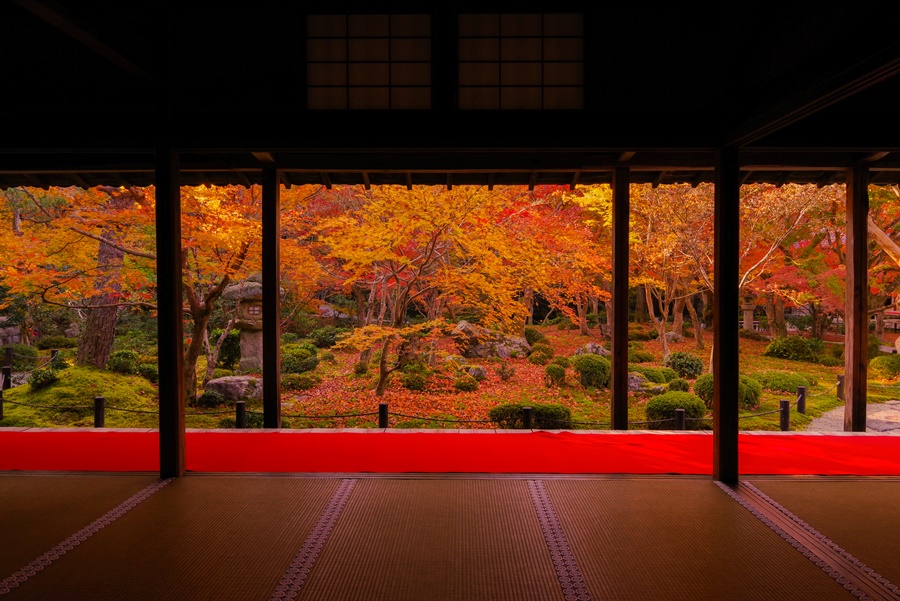
Enkoji Temple is a Rinzai Zen temple of the Nanzenji school, founded in 1601. It originated as "Enkoji Gakko," a school established by Tokugawa Ieyasu in Fushimi as part of his cultural policies, and was relocated to its current location in 1667. The temple grounds feature two gardens: the elegant Edo-period pond and strolling garden called "Jugyu no Niwa," adorned with about 200 maple trees and beautiful moss, and the dynamic Heisei-period dry landscape garden called "Honryu no Niwa," inspired by dragons and lightning. It is said that there is also a grave where the tooth of Tokugawa Ieyasu is buried, located on the hillside with a panoramic view of Rakuhoku.
Highlights of Autumn Foliage
The "Jugyu no Niwa" garden, where the autumn foliage beautifully adorns the surroundings, is famous for its "Framed Garden" view from inside the main hall, where the pillars are used as frames like a painting. The vibrant "Carpet Maple" that creates a stunning red carpet-like effect is also popular, and visiting after the peak season is recommended for sightseeing.
Detailed Information
- Access: About 15 minutes on foot from Eizan Electric Railway "Ichijoji Station" or about 10 minutes on foot from Kyoto City Bus "Ichijoji Kudarimatsucho"
- Phone Number: 075-781-8025
- Address: 13 Ichijoji Kotani-cho, Sakyo-ku, Kyoto City
- Parking: Available
- Opening Hours: 9:00 to 17:00
- Admission Fee: 500 yen
- Light-up and Nighttime Special Admission: No past records
Sanzenin Temple
Peak Season
Mid-November to late November
About Sanzenin Temple
Sanzenin is a Tendai sect temple known for its Warabe Jizo (Child Jizo) statues and served as a residence for imperial family members as the head temple of the Tendai sect. Its main attractions include two gardens: the "Shuhekien" garden, meticulously designed by the tea master Kanamori Sowa during the Edo period, and the "Yuseien" garden, featuring lush green moss. The temple also showcases prestigious buildings such as the "Shinden" and "Kyakuden" halls, as well as the important cultural property "Ojo Gokurakuin" enshrining a triad of Amida Buddha statues.
Highlights of Autumn Foliage
Sanzenin is located in the mountainous basin of Ohara, known for its drastic temperature differences, which results in vibrant and vivid autumn foliage. The contrasting colors of the beautiful green of the cedar trees and moss in the temple grounds against the backdrop of the red autumn leaves are simply breathtaking.
Detailed Information
- Access: About 10 minutes on foot from Kyoto City Bus "Ohara"
- Address: 540 Ohara Raigo-in-cho, Sakyo-ku, Kyoto City
- Phone Number: 075-744-2531
- Opening Hours: March to October: 9:00 to 17:00, November: 8:30 to 17:00, December to February: 9:00 to 16:30
- Admission Fee: 700 yen
- Light-up and Nighttime Special Admission: No past records
Kitano Tenmangu Shrine

Peak Season
Mid-November
About Kitano Tenmangu Shrine
Kitano Tenmangu Shrine is the head shrine of all Tenmangu shrines in Japan, dedicated to Sugawara no Michizane, revered as the "God of Learning." It is renowned for its blessings of academic success and entrance exam prayers, attracting many students who visit for worship. Within the shrine grounds, there is a statue of a cow called "Nadeushi," and it is believed that stroking its head brings wisdom.
Highlights of Autumn Foliage
While Kitano Tenmangu Shrine is famous for its plum blossoms, its autumn foliage is also worth seeing. In the "Momiji Garden," part of the former defensive moat built by Toyotomi Hideyoshi for the urban redevelopment of Kyoto, you can enjoy a beautiful view of approximately 350 maple trees and the vibrant red "Uguisubashi" bridge.
Detailed Information
- Access: A short walk from Kyoto City Bus "Kitano Tenmangu-mae"
- Address: Bakurocho, Kamigyo-ku, Kyoto City
- Parking: Available
- Opening Hours: 9:00 to 16:00 (Last entry at 15:40)
- Phone Number: 075-461-0005
- Admission Fee: 1,000 yen
- Momiji Garden Opening: Scheduled from October 29th to December 4th, 2022, from 9:00 to 16:00 (Last entry at 15:40)
- Light-up: Scheduled from November 12th to December 4th, 2022, from sunset to 20:00 (Last entry at 19:40)
Kifune Shrine
Peak Season
Mid-November to late November
About Kifune Shrine
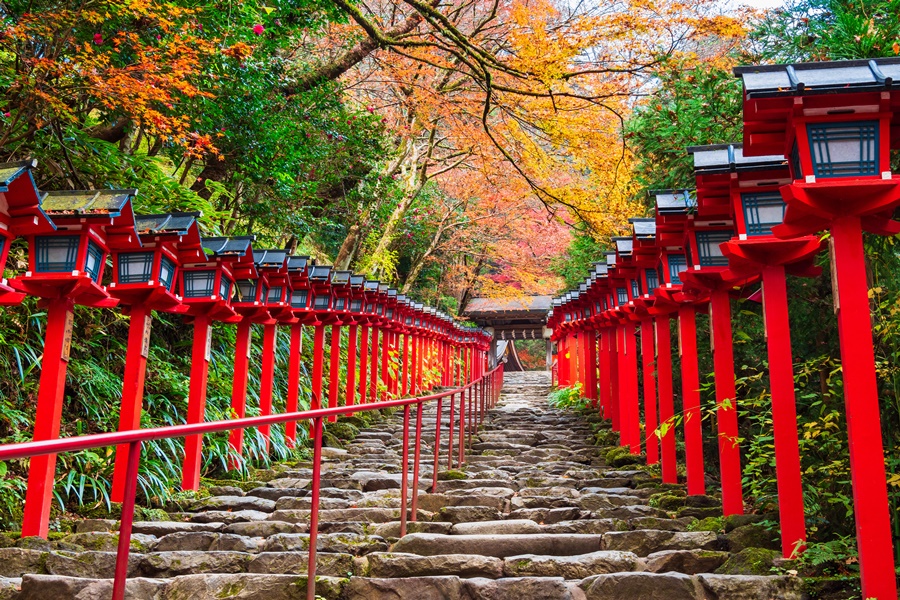
Kifune Shrine is the head shrine of approximately 500 Kifune Shrines across Japan, dedicated to the water deity Takao-kami. It is famous for its stone staircase approach adorned with lanterns. Since the Heian period, it has been associated with love and matchmaking, as it was visited by the renowned female poet Izumi Shikibu.
Highlights of Autumn Foliage
Due to its cooler temperatures compared to central Kyoto, Kifune Shrine is one of the first places to witness autumn foliage. The stone steps of the approach and the vicinity of the main shrine are enveloped in beautiful autumn colors. During the "Kifune Momiji Toro" light-up event, the area is illuminated by numerous lanterns, creating a mystical atmosphere.
Detailed Information
- Access: About a 30-minute walk from Eizan Electric Railway "Kibuneguchi Station" or about a 5-minute walk from Kyoto City Bus "Kifune"
- Address: 180 Kurama Kibunecho, Sakyo-ku, Kyoto City
- Parking: Available
- Phone Number: 075-741-2016
- Opening Hours: 9:00 to 17:00
- Admission Fee: Free
- Kifune Momiji Toro Light-up: Not yet scheduled for 2022 (Past records from 2021)
【Trending on SNS】Rurikoin Temple
Peak Season
Late November
About Rurikoin Temple
Rurikoin Temple is a Jodo Shinshu Buddhist temple located at the foot of Mt. Hiei in the Yase area. It has gained popularity in recent years for its stunning reflection photography, where the landscape of the garden is reflected on the black lacquered tables. Normally, the temple is not open to the public for cultural preservation purposes, but it offers limited-time evening special visits during spring and autumn.
Highlights of Autumn Foliage
One can capture the famous "reflection photos" and admire the beautifully colored garden landscape in shades of red and gold during the autumn foliage season. Due to its special visitation policy, advance reservation is required.
Detailed Information
- Access: About a 5-minute walk from Eizan Electric Railway "Yase-Hieizanguchi Station" or about a 5-minute walk from Hieizan Cable "Yase Station," or about a 7-minute walk from Kyoto City Bus "Yase-Ekimae"
- Address: 55 Kamitakano Higashiyama, Sakyo-ku, Kyoto City
- Parking: Not available
- Phone Number: 075-781-4001
- Opening Hours: 10:00 to 17:00 (Advance reservation required for autumn special visits)
- Admission Fee: 2,000 yen
- Autumn Special Visits & Light-up: Not yet scheduled for 2022 (Past records from 2021)
Hotel Information in the Rakuhoku/Ohara Area
The Prince Kyoto Takaragaike
A hidden gem hotel for adults, rebranded from "Grand Prince Hotel Kyoto" in 2020. It offers rooms where you can feel close to nature.
Aman Kyoto
A luxury hotel and resort nestled at the base of Mt. Daikokusan. Escape the hustle and bustle of the city and enjoy a tranquil and luxurious experience amidst serene nature.
Arashiyama, Sagano, and Takao Area
In the western part of Kyoto City, the Arashiyama and Sagano areas offer a leisurely experience of the scenic Hozu River Valley through popular attractions such as the Sagano Scenic Railway (Sagano Torokko Train) and the thrilling Hozu River Boat Ride. Including Takao, famous for its "Sanbi Meguri" (visiting three temples), here are five recommended spots to visit for autumn foliage in this area.
【Must-Visit】Togetsukyo Bridge

Peak Season
Late November to Early December
About Togetsukyo Bridge
Spanning 155 meters across the Oi River (Katsura River), Togetsukyo Bridge is a designated national scenic spot and historic site that is an essential tourist attraction in Arashiyama. It gained its name from a poem by Emperor Kameyama during the Kamakura period, who likened the sight of the moon crossing the bridge to "the moon crossing the bridge like a drifting boat."
Highlights of Autumn Foliage
The graceful curve of Togetsukyo Bridge, the gentle flow of the Katsura River, and the mountains adorned in shades of red and gold create a stunning harmony. You can enjoy the view by walking across Togetsukyo Bridge while admiring the autumn foliage or by savoring the breathtaking scenery from the riverside. The natural landscapes will captivate your heart.
Detailed Information
- Access: About a 10-minute walk from JR "Saga-Arashiyama Station," about a 2-minute walk from Keifuku Electric Railroad (Arashiyama Line) "Arashiyama Station," or right next to Hankyu "Arashiyama Station"
- Address: 40 Saga Tenryuji Mononobeba-cho, Ukyo-ku, Kyoto City
- Parking: Available
- Light-up: No past records of illumination during the autumn foliage season
Kamigamo Shrine
Peak Season
Early to Late November
About Kamigamo Shrine
Kamigamo Shrine, together with Takao's Mt. Togaoji and Sagano's Nishimyoji Temple, is known as the "Three Tail Sanctuaries" and is an esteemed temple with a rich history. It is closely associated with Kukai, the founder of Shingon Buddhism, and Saicho, the founder of Tendai Buddhism, making it an important temple in Japanese Buddhist history. It is also famous as the birthplace of the traditional ritual of throwing ceramic shards, called "Kawarake-nage," for warding off misfortune.
Highlights of Autumn Foliage
Due to its location on the slopes of Mt. Takao, Kamigamo Shrine experiences early autumn foliage. You can admire the over 500-year-old ancient tree known as "Takao Kaede" (Iroha Momiji) alongside the vibrant autumn colors. The autumn foliage that adorns the stone steps leading to the mountain gate is particularly beautiful, and the picturesque scenery after the peak season, with scattered fallen leaves, is perfect for capturing stunning photographs.
Detailed Information
- Access: About a 20-minute walk from JR Bus "Takao" or about a 20-minute walk from Kyoto City Bus "Takao"
- Address: 5 Umezakihigashi Takao-cho, Ukyo-ku, Kyoto City
- Parking: Not available
- Phone Number: 075-861-1769
- Opening Hours: 9:00 to 16:00
- Admission Fee: 600 yen
- Night Special Visits & Light-up: Not yet scheduled for 2022 (Past records from 2021)
Tenryu-ji Temple

Peak Season
Mid-November to Early December
About Tenryu-ji Temple
Established in 1339 by Ashikaga Takauji as a Zen temple of the Rinzai sect, Tenryu-ji Temple is registered as a UNESCO World Heritage site and is considered one of the cultural assets of ancient Kyoto. It is the most prestigious Zen temple in Kyoto after Nanzen-ji Temple, which is ranked first among the Kyoto Gozan (Five Mountain System).
Highlights of Autumn Foliage
Tenryu-ji Temple offers several exceptional spots for autumn foliage viewing, including the tunnel of autumn colors behind the Sogenchi Pond garden, the "Mokkei-no-Oka" hill that provides a panoramic view of Kyoto City, and the "Daihondo" hall, where you can enjoy the landscape as if it were a framed painting. There are numerous perfect locations to witness the beauty of autumn foliage.
Detailed Information
- Access: Right near Keifuku Electric Railroad (Arashiyama Line) "Arashiyama Station," about a 13-minute walk from JR "Saga-Arashiyama Station," about a 15-minute walk from Hankyu "Arashiyama Station," right near Kyoto City Bus "Tenryu-ji-mae" or right near Kyoto Bus "Keifuku Arashiyama-eki-mae"
- Address: 68 Sagatenryuji Mononobeba-cho, Ukyo-ku, Kyoto City
- Parking: Available
- Phone Number: 075-881-1235
- Opening Hours: 8:30 to 17:00 (Last entry at 16:50), Various Halls (Daihondo, Shoin, and Tahoto): 8:30 to 16:45 (Last entry at 16:30)
- Admission Fee: Garden (Sogenchi and Hyakka-en): 500 yen, Various Halls (Daihondo, Shoin, and Tahoto): additional 300 yen to the garden fee
- Sogenchi Pond Garden (Early Morning Visit): Scheduled from November 12 to November 30, 2022, at 7:30 AM
- Night Special Visits & Light-up: No past records of night special visits and light-up
Daikaku-ji Temple
Peak Season
Late November to Early December
About Daikaku-ji Temple
Daikaku-ji Temple is the head temple of the Shingon sect Daikaku-ji school. The temple's "Osawa Pond" is famous as one of Japan's three major sites for moon viewing. Originally a detached palace of Emperor Saga, it was converted into a temple and has a deep connection with the Imperial Family as "Sagano Gosho" (Sagano Imperial Villa).
Highlights of Autumn Foliage
The vermilion-colored "Shingeku Ho-to" pagoda reflecting on the surface of Hossho Pond creates a breathtaking scene. During the evening illumination, a divine and magnificent view unfolds.
Detailed Information
- Access: About a 15 to 20-minute walk from JR "Saga-Arashiyama Station"
- Address: 4 Sagadasawa-cho, Ukyo-ku, Kyoto City
- Parking: Available
- Phone Number: 075-871-0071
- Opening Hours: 9:00 to 17:00 (Last entry at 16:30)
- Admission Fee: Temple Area: 500 yen, Osawa Pond Area: 300 yen
- Night Special Visits & Light-up: Not yet scheduled for 2022 (Past records available)
Jojakko-ji Temple
Peak Season
Mid-November to Late November
About Jojakko-ji Temple
Jojakko-ji Temple is a Nichiren Buddhist temple situated on the slopes of Mount Ogura, famous for the Ogura Hyakunin Isshu anthology of Japanese poetry. From the vicinity of the Tahodo Hall, you can enjoy views extending not only to the Sagano area but also over the city of Kyoto. On clear days, you can even see Mount Hiei.
Highlights of Autumn Foliage
During autumn, the entire Mount Ogura is adorned with fall colors. The autumn foliage around the important cultural property known as the "Tahodo" hall is particularly beautiful, displaying a variety of colors, including red and gold.
Detailed Information
- Access: About a 15-minute walk from JR "Saga-Arashiyama Station," about a 20-minute walk from Keifuku Electric Railroad (Arashiyama Line) "Arashiyama Station," or about a 15-minute walk from Kyoto City Bus "Saga Shogakko-mae"
- Address: 3 Sagakurayama Oguracho, Ukyo-ku, Kyoto City
- Parking: Available
- Phone Number: 075-861-0435
- Opening Hours: 9:00 to 17:00 (Last entry at 16:30)
- Admission Fee: 500 yen
- Night Special Visits & Light-up: Not yet scheduled for 2022 (Past records available)
Hotels in the Arashiyama, Sagano, and Takao Area
Takao Kanko Hotel
A traditional Japanese inn located along the clear waters of the Kiyotaki River, offering an escape from the hustle and bustle of the city. Until the end of November, you can enjoy autumn riverside dining featuring delicacies such as matsutake mushrooms and Kyoto's yudofu (tofu boiled in hot water).
Hoshinoya Kyoto
A luxurious ryokan (traditional Japanese inn) in Arashiyama, where you can enjoy a private boat ride from Togetsukyo Bridge. With river-view rooms and Michelin-starred cuisine, staying here is a truly special experience.
Southern Kyoto Area
In the southern Kyoto area, which includes Fushimi Ward, famous for its multiple rows of vermilion torii gates at Fushimi Inari Taisha, and Yamashina Ward, associated with historical figures like Toyotomi Hideyoshi and Ono no Komachi, I will introduce three must-visit autumn foliage spots.
Bishamon-do Temple

Peak Season
Mid-November to Late November
About Bishamon-do Temple
Bishamon-do Temple is one of the five monzeki temples of the Tendai sect, where members of the imperial family served as successive chief priests. Founded by Gyoki during the Asuka period, it is located in Yamashina Ward and is known as the shrine of "Bishamonten," one of the Seven Lucky Gods associated with wealth and fortune.
Highlights of Autumn Foliage
The maple trees lining the approach to the "Chokushi Gate" create a stunning sight when their leaves cover the stone steps in vibrant red, a spectacle so remarkable that it was featured on JR posters. Additionally, you can enjoy the autumn foliage in the strolling-style garden called "Bansui-en," which exudes the atmosphere of the Edo period.
Detailed Information
- Access: About a 20-minute walk from JR "Yamashina Station," Subway "Yamashina Station," or Keihan "Keihan-Yamashina Station"
- Address: 18 Yamasaka, Anshu-Inariyama-cho, Yamashina-ku, Kyoto City
- Parking: Available
- Phone Number: 075-581-0328
- Opening Hours: March to November: 9:00 to 17:00 (Last entry at 16:30), December to February: 9:00 to 16:30 (Last entry at 16:00)
- Admission Fee: 500 yen
- Night Special Visits & Light-up: No past records available
Daigo-ji Temple
Peak Season
Mid-November to Early December
About Daigo-ji Temple
Daigo-ji Temple is the head temple of the Shingon sect Daigo school, boasting an expansive area of over 2 million square meters from the foot to the summit of Mount Daigo. It is one of the largest temple complexes in Kyoto, housing approximately 150,000 temple treasures including national treasures and important cultural properties. It is registered as a UNESCO World Heritage site as one of Kyoto's cultural assets.
Highlights of Autumn Foliage
Within the vast temple grounds, there are notable attractions such as the "Kon-do" main hall, "Goju-no-to" five-story pagoda, and "Yakushi-do" hall. Particularly popular is the autumn foliage around the "Benten-do" hall, which enshrines Benzaiten, one of the Seven Lucky Gods. During the evening light-up, the reflection of the vermilion halls and the autumn foliage in "Benten Pond" creates a beautiful scene.
Detailed Information
- Access: About a 10-minute walk from Subway "Daigo Station"
- Address: 22 Daigohigashioji-cho, Fushimi-ku, Kyoto City
- Parking: Not available
- Phone Number: 075-571-0002
- Opening Hours (Sanbo-in, Reihokan, and Garan): March to 1st Sunday in December: 9:00 to 17:00 (Last entry at 16:30), Day after the 1st Sunday in December to February: 9:00 to 16:30 (Last entry at 16:00)
- Admission Fee: 1,000 yen, Golden Week (March 20 to the last day of May): 1,500 yen
- Night Special Visits & Light-up: Not yet scheduled for 2022 (Past records available)
【Buzz on Social Media】Zuishinin Temple

Peak Viewing Season
Mid-November to Late November
What kind of temple is Zuishinin?
Zuishininis the head temple of the Shingon Sect Zenjuji School, located in Yamashina Ward. It is famous as the place where the renowned female poet Ono no Komachi spent her final years. One of its highlights is the "Gokusaishiki Baiwafu Komachi-ezu," a vibrant fusuma painting depicting the life of Ono no Komachi, featuring a striking pale pink color known as "hanegui-iro," which has been a hot topic on social media.
Highlights of Autumn Foliage
While Zuishinin is well-known for its plum blossoms in spring, the autumn foliage should not be missed. You can enjoy the vibrant colors of the foliage throughout the temple grounds and garden. It is also recommended to visit Zuishinin along with nearby attractions such as Daigoji Temple and Bishamon-do.
Detailed Information
- Access: Approximately 5 minutes on foot from Ono Station (Subway)
- Address: 35 Ono Goryocho, Yamashina Ward, Kyoto City
- Parking: Available
- Phone Number: 075-571-0025
- Opening Hours: 9:00 AM to 5:00 PM (Last admission at 4:30 PM)
- Admission Fee: 500 yen
- Nighttime Special Visits and Illumination: Schedule for 2022 to be announced (previously conducted in 2021)
Uji City and Nagaokakyo City Area
The Uji City, renowned for its Uji tea production, and Nagaokakyo City, the former capital of Japan, are two must-visit destinations outside Kyoto City. Here are four recommended autumn foliage spots in this area.
【Classic】Byodoin Temple
Peak Viewing Season
Mid-November to Early December
What kind of temple is Byodoin?
Byodoin Temple was established in 1053 by Fujiwara no Yorimichi and stands as a testament to the glory of the Fujiwara clan. The temple's main hall, known as the "Phoenix Hall" (Hoodo), is depicted on the 10 yen coin and houses the Amida Buddha statue created by Jocho. Byodoin Temple is also renowned for its garden, which replicates the Pure Land paradise. With numerous national treasures, it was designated as a World Heritage site in 1994 as part of the "Historic Monuments of Ancient Kyoto."
Highlights of Autumn Foliage
The "Aji-ike" pond in front of the Phoenix Hall is surrounded by beautiful maple trees, creating a picturesque scene with the reflection of the hall and foliage on the water's surface on sunny days.
Detailed Information
- Access: Approximately 10 minutes on foot from Uji Station (JR) or Uji Station (Keihan)
- Address: 116 Ujirenge, Uji City
- Parking: Not available
- Phone Number: 0774-21-2861
- Opening Hours: Garden: 8:30 AM to 5:30 PM (Last admission at 5:15 PM), Interior of the Phoenix Hall: 9:30 AM to 4:10 PM
- Admission Fee: 600 yen (includes admission to the Byodoin Museum Hoshokan)
- Nighttime Special Visits and Illumination: Schedule for 2022 to be announced (canceled in 2021)
Kosho-ji Temple
Peak Viewing Season
Late November to Early December
What kind of temple is Kosho-ji Temple?
Kosho-ji Temple was founded by Dogen, the founder of the Soto Zen sect. It is considered the first training hall for Soto Zen monks, aiming to provide education and training for monks. Visitors can also experience zazen meditation and copying sutras.
Highlights of Autumn Foliage
The main highlight is the approach called "Kotosaka," which leads from the stone gate to the main gate. Lined with maple trees, this beautiful foliage tunnel creates an excellent spot for photography.
Detailed Information
- Access: Approximately 25 minutes on foot from Uji Station (JR), or 15 minutes on foot from Uji Station (Keihan)
- Address: 27-1 Ujiyamada, Uji City
- Parking: Not available
- Phone Number: 0774-21-2040
- Opening Hours: From dawn to sunset (around 5:00 AM to 5:00 PM)
- Admission Fee: 500 yen
- Nighttime Special Visits and Illumination: Schedule for 2022 to be announced (previously conducted in 2021)
Mimuroto-ji Temple
Peak Viewing Season
Mid-November to Early December
What kind of temple is Mimuroto-ji Temple?
Mimuroto-ji Temple is the 30th temple of the Saigoku Kannon Pilgrimage, a series of 33 Buddhist temples dedicated to the worship of the Kannon bodhisattva. It is an ancient temple founded in the Nara period. Known as one of Kyoto's most famous flower temples, it features a vast garden called "Yoraku-en" where visitors can enjoy various seasonal flowers, including hydrangeas and azaleas.
Highlights of Autumn Foliage
Although Mimuroto-ji Temple is famous as the "Hydrangea Temple," it is also recognized as one of the "Uji Twelve Views" for its autumn foliage, known as the "Momiji (maple) of Mimuroto-ji Temple." The view of the temple's autumn foliage blending with the three-story pagoda is magnificent.
Detailed Information
- Access: Approximately 15 minutes on foot from Mimuroto Station (Keihan Line)
- Address: 21 Ushirodoshi Shigatani, Uji City
- Parking: Not available
- Phone Number: 0774-21-2067
- Opening Hours: April to October: 8:30 AM to 4:30 PM (Last admission at 3:50 PM), November to March: 8:30 AM to 4:00 PM (Last admission at 3:20 PM)
- Admission Fee: 500 yen (Additional fees apply during the opening periods of the Weeping Plum Garden, Azalea Garden, and Hydrangea Garden)
- Nighttime Special Visits and Illumination: No past records during the autumn foliage season
Komyoji Temple

Peak Viewing Season
Mid-November to Late November
What kind of temple is Komyoji?
Komyoji Temple is the head temple of the Nishiyama Jodo sect located in Nagaokakyo City. Situated in Aoshiba Koyadani, the place where Honen, the founder of the Jodo sect, is said to have first preached the practice of chanting the Nembutsu ("Namu Amida Butsu"). The temple also houses Honen's mausoleum.
Highlights of Autumn Foliage
Known as the "Maple Temple," Komyoji is adorned with hundreds of maple trees that beautifully color the temple grounds. The temple features the stone staircase "Nyonyo-zaka" leading from the main gate to the Okagedo Hall, the maple tree-lined path called "Momiji Sando" centered around the Yakuimon gate, and the stunning "Shikimomiji/Chirimomiji" that blankets the approach in vibrant red.
Detailed Information
- Access: Approximately 10 minutes on foot from Asahigaoka Home-mae Bus Stop (Hankyu Bus)
- Address: 26-1 Aoshiba Nishijo-no-uchi, Nagaokakyo City
- Parking: Not available
- Phone Number: 075-955-0002
- Opening Hours: 9:00 AM to 4:00 PM
- Admission Fee: Free (During the autumn foliage season, 1000 yen)
- Nighttime Special Visits and Illumination: No past records
Hotel Information in Uji City and Nagaokakyo City Area
Hanayashiki Ukifuneen
A traditional Japanese inn with all rooms offering a panoramic view of the Uji River. Guests can enjoy Kyoto cuisine while overlooking the cherry blossoms in spring and the autumn foliage of the surrounding mountains and the Uji River.
Discover Nagaokakyo
A designer hotel located right in front of Hankyu Nagaoka Tenjin Station, boasting the Good Design Award in 2020. It is a popular hotel where travelers and locals can mingle, and the "Machi Bar SUBACO" is also a highlight.
Experience the Stunning Beauty! Let's Visit Kyoto in its Splendid Autumn Colors
Experience the Spectacular Autumn Colors in Kyoto Kyoto is known for its breathtaking autumn foliage season, which can be considered the best season to visit throughout the year. Have you found the spots you want to visit?
If you plan to visit crowded tourist attractions, it is recommended to organize your itinerary using tours and activities that provide smooth transportation.
Why not embark on a journey to Kyoto this autumn and immerse yourself in the enchanting beauty of the fall foliage?
*Thank you for reading the article!
To improve YOKKA's service, we kindly request your participation in a survey below.
YOKKA